Nietzsche’s Circle and the Crack: The Deduction of a Logical Loop and Its Honest Deficit | 尼采的圆与裂缝:一个逻辑闭环的推演及其诚实的缺口
[中文]
文:小王子
尼采的圆与裂缝:一个逻辑闭环的推演及其诚实的缺口
引言:用锤子画圆的人
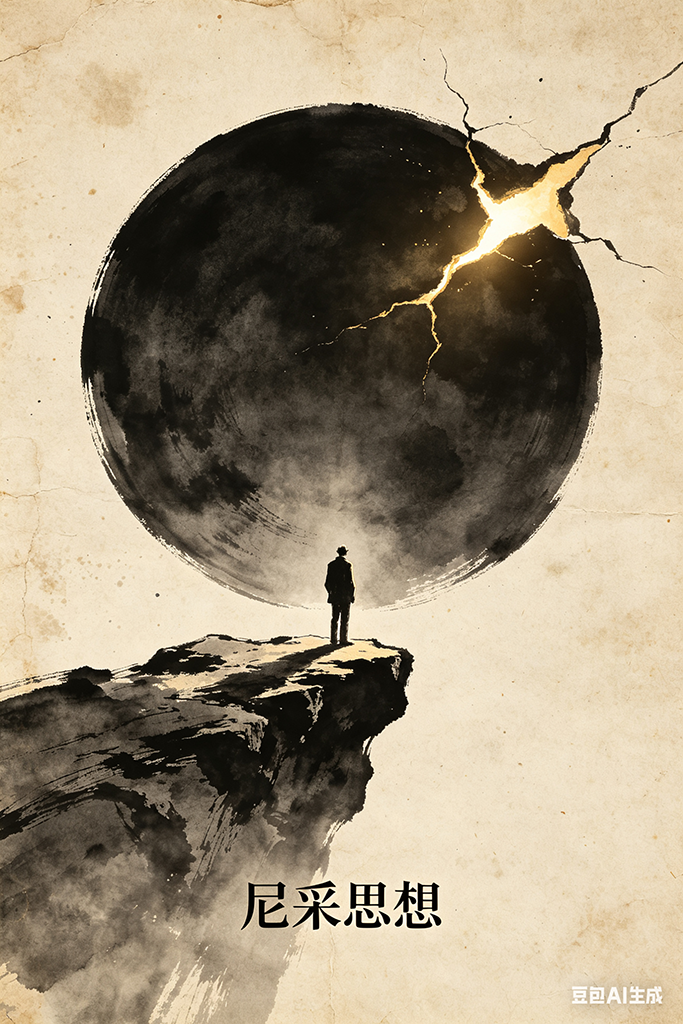
尼采是一位用锤子做哲学的思考者。他敲碎了西方形而上学的千年基石——上帝、真理、道德——然后站在废墟上,试图用这些碎石画出一个新的圆。
这个圆,就是“权力意志”统摄下的哲学闭环。它异常强健,足以解释从星辰运行到人类价值的万象。然而,尼采的真诚在于:他拒绝将最后一道裂缝焊死。他让这个圆保持着一种危险的、呼吸着的开放。
以下是这个圆的精确推演,以及它拒绝闭合的地方。
一、逻辑闭环:权力意志的自我完成
尼采哲学的核心驱动力只有一个:权力意志。它不是世俗理解的“争夺权力”,而是一切生命自我克服、自我扩张、自我超越的内在冲动。草要长高,人要创造,思想要理解——这都是权力意志的显现。
从这个唯一的起点,一个高度自洽的闭环展开了:
第一步:上帝已死(诊断) 西方文明的价值根基——基督教道德与柏拉图理念——已经崩塌。这不是尼采的“主张”,而是他观察到的历史事实。崩塌的原因是:这些旧价值是衰败的生命的产物,它们教导人否定此岸、否定肉体、否定激情。它们削弱了人的权力意志。因此,它们必须被克服。
第二步:超人(解决方案的指向) 在没有外在价值来源的荒原上,人如何活下去?尼采的回答是:自己成为价值的创造者。这个创造者,就是“超人”。超人不再仰望“你应该”的诫命,而是从存在的深处说出“我要”。他是权力意志在人这个物种中的自觉形态。
第三步:永恒轮回(价值的试金石) 如何检验一个自创的价值是真价值,而非另一种自欺?尼采提出了人类思想史上最沉重的思想实验——永恒轮回。如果你现在的生活,每一个细节,都必须一模一样地无限重复,你还能对它说“是”吗?
如果能——这就是命运之爱。这个价值就通过了检验。你不仅接受了它,你还渴望它的永恒。这是权力意志对自身的最高肯定。
第四步:视角主义(认识论的收敛) 那么,什么是“真理”?尼采的回答是:不存在上帝视角的客观真理。一切认知都是从某个特定的、有限的权力意志视角出发的解释。真理不是被发现,而是被创造。
闭合陈述 权力意志作为宇宙的第一驱动力 → 在人类领域表现为需要价值 → 旧价值因削弱权力意志而坍塌(上帝已死)→ 超人作为新价值的创造者登场 → 新价值通过永恒轮回的拷问获得其“重量” → 一切价值与真理归根结底是权力意志的视角 → 回到权力意志。
这个闭环是完整的。它不依赖任何外部的神或理念,它从自身出发,解释了自身,并最终回到自身。
二、逻辑不闭环:尼采留下的四道裂缝
然而,一个真正伟大的哲学家,其体系的裂缝往往比其完整更深刻。尼采的圆,在以下四处拒绝闭合。
裂缝之一:永恒轮回的事实性与寓言性 永恒轮回究竟是一个宇宙学事实,还是一个伦理寓言? 尼采有时试图用能量守恒与时间无限来“证明”它(事实),有时又仅仅将其作为“你如何过这一生”的最高测试(寓言)。如果是事实,它无法被证实;如果是寓言,它的力量取决于你是否“相信”它。在一个一切信仰都已坍塌的时代,谁来为这个最沉重的信仰提供根基?这个裂缝,是虚无主义深渊在尼采体系内部的一次回响。
裂缝之二:权力意志的自我指涉 视角主义断言:一切真理都是权力意志的视角。 那么,“一切真理都是权力意志的视角”这个陈述本身,是否也只是一个视角? 如果“是”,那么它并不比别的视角更“真”;如果“不是”,那么就存在一个例外的、非视角的真理,视角主义因此自相矛盾。尼采没有彻底解决这个说谎者悖论的变体。这个裂缝,是理性在其自我批判的极限处必然遭遇的困境。
裂缝之三:超人的沉默 尼采极其详尽地描述了超人的功能——创造新价值、克服虚无主义。但他几乎完全沉默于超人的内容——他创造什么价值? 如果他规定内容,他就成了他毕生反对的旧形而上学家(新的牧师)。如果他不规定内容,超人就成了一个空洞的X,任何人都可以把自己的意志填进去。后来的历史——尤其是纳粹对尼采的利用——证明了这道裂缝是多么危险。这个裂缝,是自由在拒绝一切规定后所必然面对的虚空。
裂缝之四:与自身生命的背离 尼采的文字赞美健康、力量、上升的生命。但他本人一生被病痛折磨,离群索居,最终精神崩溃。 一个被生命“击败”的人,如何成为“肯定生命”的最高先知?最有力的辩护是:他的哲学正是他对自身痛苦的克服——他在最衰弱的肉体里,写下了最强的肯定。但裂缝依然存在:这种克服,最终没能阻止他的崩溃。这道裂缝,是存在与言说之间永远无法弥合的距离。
结语:裂缝中的真诚
尼采的逻辑闭环是哲学史上最强健的构造之一。但他最伟大的地方,或许不在于画出了这个圆,而在于他拒绝缝合那些裂缝。
他拒绝用一个新的、虚假的绝对去填补“上帝已死”留下的空位。他拒绝成为新的偶像。他宁可让那个裂缝敞开着,让虚无的风从中穿过,也不愿用一个廉价的答案去堵住它。
那个裂缝,就是尼采版本的“差一丝”。 它不是一个体系的缺陷。它是一个思考者对深渊的诚实。
当你在阅读尼采时,如果你只看见了一个完美的圆,那你可能错过了他。如果你看见了那些裂缝,并依然能对他的追问说“是”——那你或许正在接近他所说的命运之爱。
[Note:]
Here is the English reconstruction, designed to carry the weight of that "Honest Gap"
[English]
Author:Little Prince
Nietzsche’s Circle and the Crack: The Deduction of a Logical Loop and Its Honest Deficit
Introduction: The Man Who Drew Circles with a Hammer
Nietzsche was a thinker who philosophized with a hammer. He shattered the millennial foundations of Western metaphysics—God, Truth, Morality—and then, standing upon the ruins, attempted to draw a new circle using those very shards.
This circle is the philosophical closed-loop governed by the Will to Power. It is robust enough to explain everything from the movement of stars to the hierarchy of human values. Yet, Nietzsche’s brilliance lies in his refusal to weld the final crack shut. He allowed the circle to remain dangerously open, breathing.
Here is the precise deduction of that circle, and the points where it refuses to close.
I. The Logical Loop: The Self-Completion of the Will to Power
The driving force of Nietzsche’s philosophy is singular: The Will to Power. It is not a vulgar quest for political dominion, but the internal impulse of all life toward self-overcoming, self-expansion, and self-transcendence.
From this starting point, a highly self-consistent loop unfolds:
1. God is Dead (The Diagnosis): The foundational values of Western civilization—Christian morality and Platonic idealism—have collapsed. This is an observed historical fact. These "old values" were the products of declining life; they taught man to negate the body and the passions. Thus, they must be overcome.
2. The Ubermensch (The Direction of the Solution): In the wasteland where external sources of value have vanished, how does one live? Nietzsche’s answer: Become the creator of your own values. The Ubermensch (Overman) does not look up to "Thou Shalt"; he speaks "I Will" from the depths of his existence.
3. Eternal Recurrence (The Touchstone of Value): How can one test if a self-created value is genuine? Nietzsche proposes the heaviest thought experiment: Eternal Recurrence. If your life, in every detail, were to repeat identically for eternity, could you say "Yes" to it? If so, this is Amor Fati (Love of Fate). The value is verified.
4. Perspectivism (The Epistemological Convergence): What, then, is "Truth"? Nietzsche argues there is no "God’s eye view." All cognition is an interpretation originating from a specific, limited perspective of the Will to Power. Truth is not discovered; it is created.
The Closing Statement: The Will to Power as the primal drive → Manifests as a need for values → Old values collapse for weakening the Will (God is Dead) → The Ubermensch emerges as the creator of new values → New values gain "weight" through the test of Eternal Recurrence → All values and truths return to the Will to Power as perspective. The loop is closed.
II. The Logical Deficit: The Four Cracks Nietzsche Left Behind
The greatness of a philosopher is often found in their cracks rather than their completion. Nietzsche’s circle refuses to close in four profound places:
Crack 1: The Factuality vs. Allegory of Eternal Recurrence Is Eternal Recurrence a cosmological fact or an ethical allegory? Nietzsche sometimes tried to "prove" it using energy conservation and infinite time (fact), and at other times used it merely as a test for how to live (allegory). If a fact, it is unprovable; if an allegory, its power depends on "belief." In an age of shattered beliefs, what provides the foundation for this heaviest of faiths? This crack is the echo of the Abyss of Nihilism within his own system.
Crack 2: The Self-Reference of Perspectivism Perspectivism asserts: "All truth is but a perspective of the Will to Power." Does this statement itself also represent a perspective? If yes, it is no more "true" than any other; if no, then there exists an exceptional, non-perspectival truth, and Perspectivism contradicts itself. This crack is the Liar’s Paradox at the limit of rational self-critique.
Crack 3: The Silence of the Ubermensch Nietzsche describes the function of the Ubermensch in detail but is silent on his content. What values does he create? If Nietzsche prescribed the content, he would become the very thing he loathed: a new metaphysician or priest. If he remains silent, the Ubermensch is an empty "X" into which anyone can pour their own will—a crack that history (and the Nazis) proved to be terrifyingly dangerous. This is the Void of Absolute Freedom.
Crack 4: The Divergence from His Own Life Nietzsche’s prose celebrates health, strength, and ascending life. Yet, he lived a life of agonizing illness, isolation, and eventual mental collapse. How can a man "defeated" by life be the prophet of "affirming" life? The crack remains: his philosophy was a heroic overcoming of his suffering, but that overcoming could not prevent his breakdown. This is the Distance between Existence and Discourse.
Conclusion: Honesty Within the Crack
Nietzsche’s logical loop is one of the most robust constructions in the history of thought. But his greatest achievement was not drawing the circle—it was refusing to seal the cracks.
He refused to fill the void left by the "Death of God" with a new, false absolute. He preferred to let the crack stay open, letting the wind of nothingness blow through, rather than plugging it with a cheap answer.
That crack is Nietzsche’s version of "The Missing Inch" (差一丝). It is not a flaw in the system; it is the Honesty of a Thinker facing the Abyss.
To see Nietzsche is to see the cracks. If you can see them and still say "Yes" to his questioning, then you are approaching what he truly meant by the Love of Fate.